
5 mins

Multiple structural forces are reshaping terminal sterilization for medical devices in parallel.
1. The State of Play
Three structural shifts are running in parallel across the medical device landscape, each only partly connected to the others.
Regulatory Pressure on Ethylene Oxide (EtO)
Regulatory pressure has not moved as a single global wave, but rather as a complex patchwork of national and supranational actions with completely different statutory bases.
United States: EtO is regulated simultaneously under the Clean Air Act (the NESHAP rule governing facility emissions) and under FIFRA (registration review of EtO as a pesticide), producing overlapping but distinct compliance obligations. The 2024 NESHAP rule covered 89 affected US commercial sterilization facilities and targeted a 90% reduction in emissions. A March 2026 proposal by the EPA to reconsider this rule would rescind risk-based standards promulgated under CAA section 112(f)(2), revise technology-based standards under section 112(d)(6) for new aeration room vents at higher-use facilities, and allow facilities to choose between parametric and continuous emission monitoring. The comment period for this proposal closed on May 1, 2026. Sitting independently alongside this track, the FIFRA Interim Decision issued on January 14, 2025, imposes phased risk mitigation requirements with compliance deadlines spanning from 60 days to ten years. The FIFRA decision remains independently operative regardless of the NESHAP outcome.
Europe: The European Commission concluded that EtO used to sterilize medical devices during manufacturing falls outside the Biocidal Products Regulation (BPR), because BPR Article 2(2)(b) excludes biocidal uses already governed by the MDR or IVDR. The Medical Device Coordination Group formalized this position via MDCG 2024-13 in October 2024. EtO sterilization is now controlled through the manufacturer's validation processes and assessed by notified bodies as part of MDR conformity assessment rather than through ECHA. This shift is a framework clarification, not a deregulation; notified bodies have intensified scrutiny of validation files, while Member State environmental regulators continue to apply national air quality rules. Additionally, EtO remains classified as a CMR (carcinogenic, mutagenic, reproductive toxicant) substance under REACH/CLP, and occupational exposure is strictly regulated via Directive 2004/37/EC.
Normalization of Cobalt-60 Supply
The gradual recovery of cobalt-60 (Co-60) follows an acute supply squeeze experienced between 2018 and 2024. Co-60 is produced almost exclusively in roughly 40 reactors globally, primarily CANDU pressurized heavy water reactors (located in Canada, China, India, and Argentina) and historically in RBMK light water graphite-moderated reactors in Russia. The historical squeeze was driven by concurrent Canadian and Argentinian refurbishment programs, Russian distribution disruptions, and demand growth that reached double the historic rates.
Supply has moved toward normalization as major Canadian refurbishments target completion in 2026 and 2033. Bruce Power and Nordion have expanded production capacity, while CNNC in China has grown to supply roughly a quarter of the Asian market and is exporting to Indian pharmaceutical manufacturers. In tandem, India's Board of Radiation and Isotope Technology continues to scale domestic production. Notably, a Westinghouse-Nordion-PSEG initiative announced in January 2026 established long-term agreements for the first-ever commercial-scale Co-60 production in US pressurized water reactors at PSEG's Salem nuclear generating station in New Jersey, targeting implementation in 2026 subject to NRC authorization. However, because supply remains structurally concentrated among three main entities (BWXT in Canada, Rosatom in Russia, and CNNC in China), single geopolitical or operational events can still trigger regional dislocations.
Rapid Expansion of Alternative Modalities
X-ray and vaporized hydrogen peroxide (VHP) capacities are expanding fast on both sides of the Atlantic. In June 2025, Steri-Tek agreed with IBA to install a Be Wide X-ray system in Lewisville, Texas, expanding the facility’s processing capacity fivefold by allowing full-pallet sterilization across a wide density range. Sterigenics similarly announced expanded X-ray capacity in the southeast United States in May 2025, with European installations tracking a similar trajectory. For VHP, the FDA recognized ISO 22441 in July 2023 and subsequently reclassified the modality from Established Category B to Established Category A in 2024, significantly lowering the regulatory barrier for 510(k) submissions. Notified bodies in the EU have similarly begun reviewing VHP submissions with increasing familiarity.
For wound care manufacturers, the planning horizon must span all three structural movements; these are permanent market resets operating on independent timelines.
2. Comparison of the Four Established Modalities
Four key modalities account for almost all terminal sterilization of wound care devices today: ethylene oxide, gamma irradiation, electron beam, and X-ray. Traditional steam and dry heat sterilization are out of scope for most modern wound care products due to severe material incompatibility.
Ethylene Oxide (EtO)
Mechanism: EtO acts as an alkylating agent that disrupts microbial DNA, RNA, and protein function by binding directly to nucleophilic groups.
Strengths: It operates at low temperatures (typically 30 to 60 °C), possesses exceptional penetration through complex geometries and porous materials, and is compatible with a wide array of polymer chemistries. It sterilizes roughly half of all US medical devices.
Wound Care Fit: Standard for multi-component kits, long/narrow lumens, negative pressure wound therapy (NPWT) dressings, tubing assemblies, and combination products incorporating drug or biologic actives that cannot tolerate radiation.
Constraints: EtO is a known carcinogen, mutagen, and reproductive toxicant. It leaves highly regulated residues in porous, hygroscopic materials like alginates, carboxymethylcellulose (CMC) fibers, foams, and hydrogel matrices. Residue limits are strictly governed by ISO 10993-7, often mandating lengthy aeration cycles measured in days rather than hours to safely deplete ethylene oxide and ethylene chlorohydrin residues.
Gamma Irradiation
Mechanism: Utilizes high-energy photons emitted by the radioactive decay of Cobalt-60 to cause direct strand scission in microbial DNA and generate destructive hydroxyl radicals from water.
Strengths: Exceptional penetration depth. A standard 25 kGy dose can be delivered uniformly through dense, mixed-material pallets. It serves as the historical workhorse for high-volume single-use dressings shipped in final retail packaging.
Wound Care Fit: Extensively used for legacy wound dressings, sutures, and polymer-based devices. FDA Class II Special Controls guidance documents frequently cite gamma and EtO as the baseline sterilization methods.
Constraints: Beyond Co-60 supply chain risks, gamma presents severe dose-interaction risks with sensitive polymers. Ionizing radiation causes parallel crosslinking and chain scission. Polylactic acid (PLA) and polylactic-co-glycolic acid (PLGA) suffer molecular weight reduction and mechanical degradation; specific hydrogel chemistries can turn acidic or cytotoxic; collagen matrices can crosslink to the point of extreme brittleness; and vital protein or growth factor actives in cellular/acellular products are typically inactivated.
Electron Beam (E-beam)
Mechanism: Directly shoots electrons accelerated typically to 10 MeV at the product. It shares gamma’s microbiological mechanism (DNA scission and free radical generation) but delivers the entire target dose in seconds rather than hours.
Strengths: Shorter exposure times and high dose rates frequently lead to less material degradation than gamma at identical doses, particularly for polymers where prolonged oxygen exposure during irradiation drives oxidative degradation.
Wound Care Fit: Ideal for low-density polymer dressings, films, radiation-sensitive hydrogels, and bioresorbable polymers.
Constraints: Penetration depth is severely limited. At 10 MeV, single-sided e-beam penetration is approximately 3.9 g/cm², translating to roughly 4 cm in unit-density material. While dual-beam configurations (irradiating the product from both sides) roughly double this effective range and allow full-pallet sterilization of low-density loads, e-beam cannot penetrate dense or highly heterogeneous pallets effectively. It is poorly suited for densely packed shipping cartons containing mixed dressing kits.
X-ray (Bremsstrahlung)
Mechanism: Generated by accelerating electrons into a high-Z target (typically tungsten), producing high-penetration photons that cause strand scission and free radical generation.
Strengths: Sits functionally between gamma and e-beam: it delivers photon-based penetration comparable to gamma, but is electrically driven with no radioactive source footprint.
Wound Care Fit: Represents the lowest-friction migration path for products currently validated to gamma, as the material dose response to X-ray photons closely tracks gamma responses.
Constraints: While validation requirements are typically reduced compared to an EtO or e-beam switch, true equivalence is not automatic. Dose rate differences, specialized dose mapping, and product-specific material performance verification must still be scoped product by product.
Technical Modality Matrix
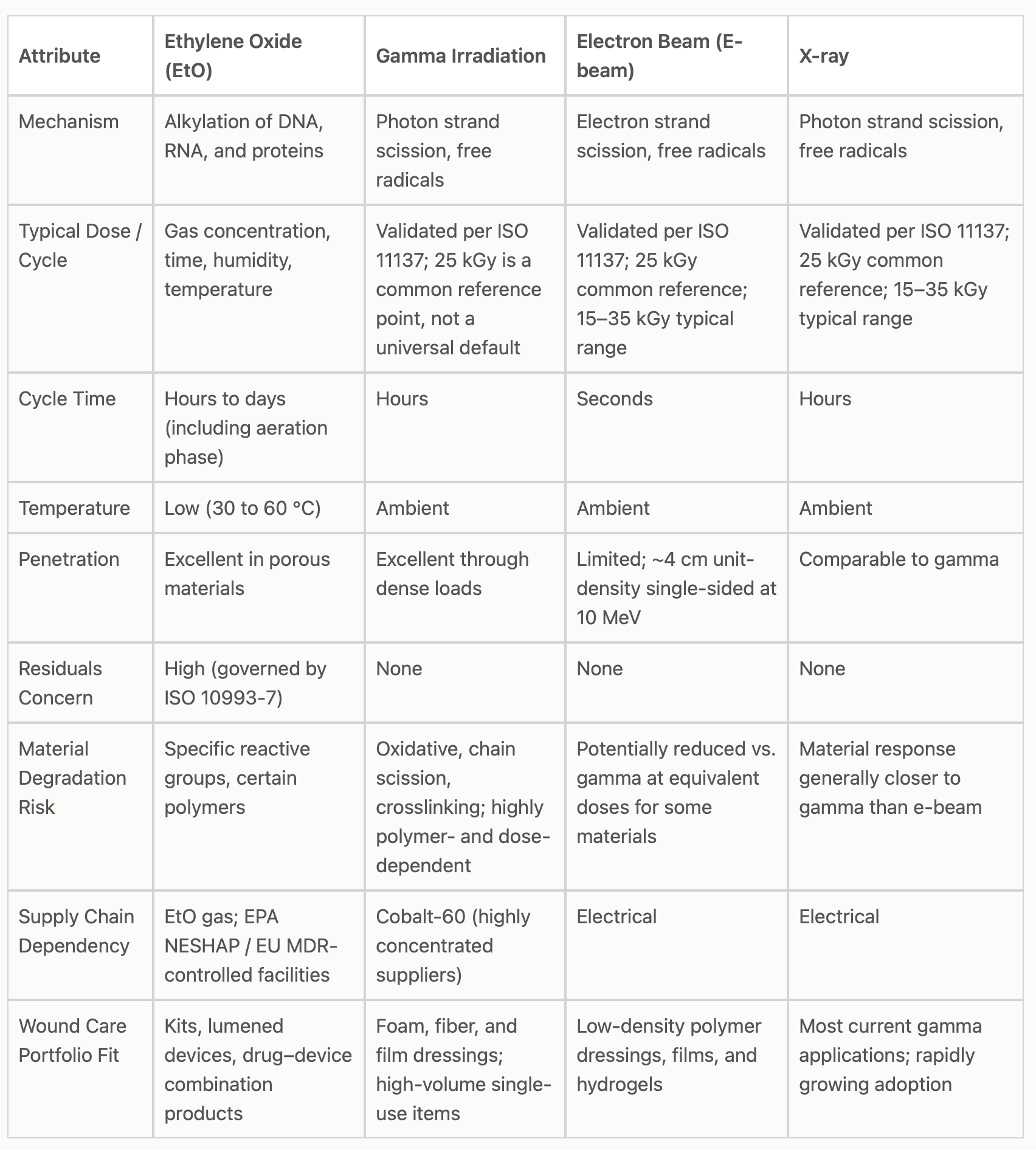
Strategic Takeaway: The choice between modalities is rarely binary. For a manufacturer with a diverse wound care portfolio, the realistic answer is a primary modality plus a qualified backup, selected per product family based on material compatibility, packaging density, validated capacity in the target geography, and regulatory pathway.
3. Vaporized Hydrogen Peroxide and Emerging Modalities
Vaporized Hydrogen Peroxide (VHP)
VHP is the most credible near-term addition to the wound care sterilization toolkit.
Mechanism: Hydrogen peroxide vapor at low concentration and low temperature sterilizes primarily through oxidative damage to cell components—denaturing proteins, disrupting cell membranes, and damaging nucleic acids via reactive oxygen species. This mechanism is distinct from ionizing radiation, as VHP does not cause the bulk chain scission or free-radical generation in polymer matrices that characterize gamma and e-beam.
Wound Care Fit: Highly attractive for hydrogels with low moisture tolerance to radiation, specific protein-containing products that cannot survive EtO residuals or radiation doses, and products containing electronic components (such as wearable NPWT devices) that are temperature-limited.
Constraints: VHP does not penetrate deep crevices, sealed packaging, or porous mated surfaces as effectively as EtO, and validated load configurations remain narrow. Upstream bioburden control is highly critical because VHP's lethality margin is smaller than that of radiation.
Minor Modalities to Watch
Nitrogen Dioxide (NO₂): Commercialized primarily by Noxilizer, NO₂ operates at low temperatures with short cycle times. Noxilizer raised $30M in growth capital in September 2025 to expand commercial-scale access to its platform. It has secured regulatory recognition in specific US and EU pathways but is not yet a mainstream alternative.
Supercritical CO₂: Investigated for tissue allografts and biologics where the absolute preservation of biological activity is the dominant constraint. Commercial-scale adoption remains tightly limited.
4. The Regulatory Landscape Across Geographies
While the technical baseline for sterilization validation is largely harmonized globally through ISO consensus standards, major geographic divergences arise in enforcement depth, supplementary national frameworks, and change-control handling.
Harmonized Technical Standards
A manufacturer validating to current versions of these core standards establishes a defensible technical baseline across almost all major jurisdictions:
ISO 11135: EtO process development, validation, and routine control.
ISO 11137 (Parts 1, 2, 3): Radiation sterilization requirements (gamma, e-beam, X-ray). Part 2 specifies dose-setting methodologies including Method 1, Method 2, and Method VDmax.
ISO 22441: VHP sterilization process requirements (published 2022, FDA recognized 2023).
ISO 10993-7: EtO residuals allowable daily intake limits based on contact duration.
ISO 11737 (Parts 1 & 2): Bioburden enumeration and tests of sterility foundational to validation.
ISO 11607 (Parts 1 & 2): Packaging validation requirements for terminally sterilized medical devices.
Regional Regulatory Frameworks
United States
The FDA reviews validation parameters within 510(k), De Novo, or PMA submissions. The vast majority of wound care products fall under the 510(k) pathway, where conformance to recognized ISO standards is sufficient. To facilitate sterilization changes without requiring full new 510(k) device re-clearance, the FDA launched three voluntary Master File Pilot Programs between 2019 and 2023 (each capped at nine sterilization provider participants):
EtO Sterilization Master File Pilot for PMA holders (November 2019).
510(k) EtO Sterility Change Master File Pilot (May 2022) – The most relevant pilot for wound care portfolios. It enables 510(k) holders to reference an accepted master file in internal documentation to support changing from fixed-chamber EtO to an approved alternative process without submitting a new 510(k).
Radiation Sterilization Master File Pilot for PMA holders (April 2023) – Restricted to PMA devices because shifting between Established Category A radiation methods (gamma to X-ray to e-beam) generally does not require a new 510(k) under existing guidance for cleared devices.
Uptake has been gradual: the EtO PMA pilot has five of nine slots filled, and Andersen Sterilizers received the first 510(k) pilot master file award in August 2023 for its EO-Flexible Chamber Technology. At the facility level, operations remain governed by the dual statutory tracks of EPA NESHAP (emissions) and FIFRA (occupational exposure), with the 2026 NESHAP reconsideration affecting the emissions track only.
European Union
Under EU MDR (Regulation 2017/745), processes must be validated to harmonized standards as part of conformity assessments conducted by Notified Bodies. MDCG 2024-13 clarified that manufacturing-stage EtO falls under MDR rather than the Biocidal Products Regulation (BPR), focusing regulatory attention on the manufacturer's validation file rather than active substance authorization.
This is a clarification of framework, not a deregulation; notified bodies have significantly intensified validation file reviews since 2021, and legacy files accepted under the old MDD are routinely scrutinized or rejected during MDR recertification. Common deficiencies include incomplete materials compatibility profiles, insufficient justification of dose choices (especially around VDmax15), lack of dual-modality contingency mapping, and gaps in bioburden monitoring across site changes. Simultaneously, national environmental rules (particularly tight Belgian and Dutch EtO emission standards) apply independently, altering contract sterilizer pricing and availability. For the UK market, post-Brexit UKCA marking requirements remain technically aligned with EU MDR, though the MHRA maintains its own strategic roadmap.
Asia-Pacific (APAC)
Japan's PMDA accepts core ISO standards applied through the J-GMP framework during marketing authorization. China's NMPA similarly relies on ISO standards but introduces specific national overlays, such as rigorous bioburden monitoring frequency mandates for radiation-sterilized devices. Australia's TGA aligns via its Essential Principles framework. The principal challenge for manufacturers exporting to or sourcing from APAC is supplier auditing and traceability, as local expectations can differ significantly in audit depth and bioburden monitoring frequency. CNNC's expanding role in regional Co-60 supply and a burgeoning Indian and Southeast Asian contract sterilization base have created a parallel sterilization geography operating to ISO standards but demanding distinct supplier quality management.
Latin America
Brazil's ANVISA applies ISO standards under RDC 665/2022 alongside INMETRO certification for specific sterilization activities. Mexico's COFEPRIS aligns broadly with US FDA expectations. Across the region, contract sterilization capacity is highly concentrated, making supplier qualification a more material risk than framework divergence.
5. Five Critical Validation Pitfalls
Pitfall 1: Material Degradation Underestimated at Dose-Setting
Radiation modifies polymer chemistry. The most frequent failure mode is selecting an ionizing radiation dose adequate for bioburden reduction but failing to characterize it against long-term material performance, an issue that often surfaces late during real-time stability testing.
Affected Matrices: Collagen-based matrices crosslink at 25 kGy to the point of brittleness; hydrogels undergo chain scission that destroys swelling capacity, alters water contact angles, and drops pH toward acidity; bioresorbable polymers (PLA, PGA, PLGA) suffer molecular weight reductions that change mechanical and degradation profiles. Academic literature, including Bhatnagar et al. (2016) on PEG-based bioresorbable polymers and Pohan et al. (2020) on polyvinyl alcohol (PVA) hydrogels, documents the steep curve of these degradation effects. For EtO, equivalent issues include undesirable esterification of carboxylic acids in specific matrices or oxidation of active components. Combination products with drug or growth factor elements are highly vulnerable.
Mitigation: Complete rigorous materials characterization across a broad dose range (e.g., 15 to 35 kGy) beforefinalized dose selection to support Method 1, Method 2, or VDmax validation pathways, rather than defaulting blindly to a legacy 25 kGy baseline.
Pitfall 2: EtO Residuals and Aeration Kinetics Miscalculated
Wound care products uniquely combine prolonged tissue contact with high-surface-area, highly absorbent architectures (foams, alginates, gelling fibers) that retain EtO and ethylene chlorohydrin (ECH) with high efficiency.
The Error: Treating the aeration phase as a fixed, boilerplate cycle parameter rather than an asset-specific optimization. Highly porous materials require aeration times extending one to two weeks at controlled temperatures to safely desorb gas to levels compliant with ISO 10993-7. Manufacturers who validate aeration on dry, non-porous reference materials and apply that exact cycle to high-absorbency dressings routinely fail residual testing and downstream ISO 10993-5 cytotoxicity evaluations.
Mitigation: Enforce worst-case product selection during EtO validation. Perform baseline residue extractions on the most absorbent product within a family, and treat aeration time as a validated parameter anchored strictly to that worst case.
Pitfall 3: Ignoring Dose Uniformity Ratio (DUR) Boundaries
The Dose Uniformity Ratio (DUR = Dmax / Dmin) defines the spread between maximum and minimum delivered doses within a load, governed by ISO 11137-3. The minimum dose must achieve terminal sterility, while the maximum dose must remain safely below the material's degradation threshold.
The Error: This pitfall is acute for e-beam and for X-ray on dense or heterogeneous loads. For instance, if a pallet of hydrogel dressings is stacked too thickly, the outer boundaries become over-exposed and degraded, while the inner core fails to receive the minimum validated dose required to guarantee sterility. This results in either non-sterile product escaping to market or massive inventory quarantines following routine dose-mapping audits.
Mitigation: Execute comprehensive dose mapping on worst-case load configurations. This must include both the densest commercial pallet configuration and the lowest-density configuration typical of low-volume production runs. Mapping a single nominal configuration guarantees boundary failures during routine production.
Pitfall 4: Misaligned Accelerated Aging and Real-Time Stability
Terminal sterilization initiates ongoing chemical processes. Free radicals generated via radiation persist inside polymer matrices, driving oxidative degradation over months, while EtO residues can continue to slowly desorb. Consequently, a product that passes all technical specifications immediately post-sterilization may fail them at 12, 24, or 36 months.
The Error: Relying entirely on accelerated aging data under ASTM F1980. Accelerated aging models assume linear Arrhenius degradation kinetics. However, free radical-driven oxidation in irradiated polymers is often highly non-Arrhenius; accelerated aging models routinely under-predict real-time long-term failure rates, leading to post-market stability complaints and recalls.
Mitigation: Run both real-time stability testing and accelerated aging arms in parallel from the start. Constrain formal regulatory shelf-life claims by whichever arm matures more conservatively.
Pitfall 5: Treating Dual-Modality Qualification purely as Procurement
Many manufacturing organizations assume that qualifying a backup sterilization modality is a straightforward procurement or supply-chain logistics exercise that can be initiated on short notice during a crisis.
The Error: It is actually a demanding 12-to-18-month technical validation exercise. Validating a second modality requires full material compatibility profiling, dose-setting or cycle development, DUR or residual studies, full biocompatibility re-testing (due to different extractables/leachables profiles), and brand-new real-time stability initiation. Manufacturers who began dual qualification only after primary supplier disruptions (such as the historic Sterigenics Willowbrook seal order) suffered severe, multi-month market stockouts.
Mitigation: Treat sterilization modality selection as a portfolio-level strategic asset reviewed annually. Ensure at least one secondary backup modality is fully validated and maintained in the background for every high-volume product family, independent of immediate supply chain stability.
6. Forward-Looking Horizon: What to Watch
Cobalt-60 Stabilization: The acute supply shocks of 2018–2024 are normalizing. Canadian Darlington refurbishment completions in 2026 and subsequent programs in 2033 will inject significant capacity. Crucially, alternative PWR production pathways—such as the Westinghouse-Nordion-PSEG New Jersey Salem reactor initiative (targeting 2026 implementation) and the Framatome-EDF studies targeting technical validation before 2030—will broaden the global production base beyond CANDU and RBMK reactors for the first time.
X-ray Scale Sufficiency: Installed X-ray capacity represents the most consequential near-term market pivot. Ongoing capacity rollouts from Steri-Tek, Sterigenics, and European providers mark a step-change in commercially accessible, high-penetration, electrically driven processing. For gamma-validated wound care lines, it represents the lowest-friction transition path available.
VHP Maturity: Driven by FDA’s Established Category A reclassification, VHP validation is becoming highly defensible for advanced portfolios containing hydrogels, biological components, or integrated wearable electronics.
The APAC Axis: The emergence of a parallel Asian sterilization base—anchored by CNNC’s expanding regional Co-60 footprint, India’s domestic scaling, and growing Southeast Asian contract operations—is a critical strategic variable. For manufacturers distributing into or sourcing from APAC, this geography is becoming operationally definitive regardless of where primary regulatory approvals reside.
7. References
Bhatnagar, D., Dube, K., Damodaran, V. B., et al. (2016). Effects of Terminal Sterilization on PEG-Based Bioresorbable Polymers Used in Biomedical Applications. Macromolecular Materials and Engineering, 301(10), 1211–1224.
De Lauretis, A., Eriksson Agger, A., Pal, A., et al. (2025). Balancing sterilization and functional properties in Poloxamer 407 hydrogels: comparing heat and radiation techniques. Regenerative Biomaterials, 12.
Jeong, J. O., Jeong, S. I., Park, J. S., et al. (2025). One step gamma-ray induced crosslinking and sterilization of electrospun poly(ε-caprolactone)/collagen composite scaffolds. Materials Advances.
Lambert, B. J., Mendelson, T. A., & Craven, M. D. (2011). Radiation and Ethylene Oxide Terminal Sterilization Experiences with Drug Eluting Stent Products. AAPS PharmSciTech, 12(4), 1116–1126.
Pohan, G., Mattiassi, S., Yao, Y., et al. (2020). Effect of Ethylene Oxide Sterilization on Polyvinyl Alcohol Hydrogel Compared with Gamma Radiation. Tissue Engineering Part A, 26(19–20), 1077–1090.
Regulatory & Industry Sources: ISO 11135:2014/Amd 1:2018, ISO 11137-1/-2/-3, ISO 22441:2022, ISO 10993-5, ISO 10993-7, ISO 11607-1/-2, ISO 11737-1/-2, ASTM F1980. US FDA Master File Pilot Program Documentation (2019, 2022, 2023). US EPA NESHAP Reconsideration (March 2026) & FIFRA Interim Decision (January 2025). European Commission MDCG 2024-13. Industry Capacity Announcements (Sterigenics, Steri-Tek/IBA, Nordion/Westinghouse/PSEG, Noxilizer, EDF/Framatome, 2025–2026).
Technical & Regulatory Disclaimer
This article provides a comprehensive technical and regulatory overview for informational purposes only. Sterilization modality selection and implementation must be confirmed through product-specific validation protocols. This includes full sterilization validation (ISO 11135, ISO 11137, or ISO 14937 as applicable), packaging validation (ISO 11607), biocompatibility and residual evaluation (ISO 10993 series), and real-time shelf-life and stability testing. Regulatory demands and expectations vary significantly based on specific national jurisdiction, market history, and individual product risk classification. Nothing contained herein constitutes formal regulatory or legal advice for a specific medical device product or active regulatory submission.